11 March - 17 March
Section outline
-

FOCUS / ARONGA learning intentions:
- We are FOCUSING on Ngā Pakanga o Aotearoa | The New Zealand Wars by describing ways the Crown asserted its power
- We are FOCUSING on Ngā Pakanga o Aotearoa | The New Zealand Wars by discussing the impacts of colonial rule on Māori
- We are FOCUSING on Ngā Pakanga o Aotearoa | The New Zealand Wars by describing action Māori have taken to affirm tino rangatiratanga
- We are FOCUSING Ngā Pakanga o Aotearoa | The New Zealand Wars by explaining Waitangi Tribunal processes and settlements
- We are FOCUSING on Ngā Pakanga o Aotearoa | The New Zealand Wars by identifying opportunities for Māori and non-Māori to engage and reconcile
Land Settlements
In this part of the unit, you will:
Identify and describe the Wairau Incident as a conflict resulting from the Treaty of Waitangi
The Wairau Incident of 1843
In 1843, the first major disagreement between Maori and Europeans over land (following the signing of the Treaty of Waitangi) took place at Tua Marina just north of present-day Blenheim in the South Island. The result was fighting and death.
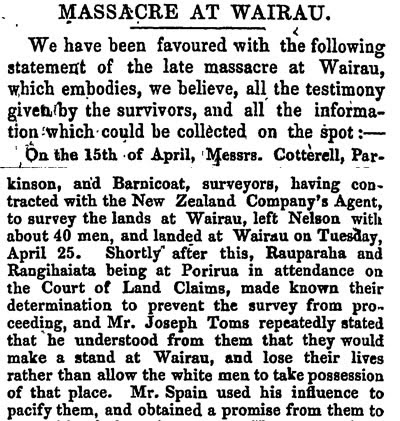
On 17 June 1843, 22 Europeans and four Māori were killed when an armed party of New Zealand Company settlers clashed with Ngāti Toa over the purchase of land in the Wairau Valley. This affray at Tuamarina, 10 km north of today’s town of Blenheim, was the first significant armed conflict between Māori and British settlers after the signing of the Treaty of Waitangi.
Nine of the Europeans had been executed after surrendering, and outraged settlers demanded action against Ngāti Toa. They were disappointed when the new governor, Robert FitzRoy, judged that the Māori had been provoked by the Europeans. FitzRoy’s subsequent inaction was widely condemned by Pākehā, but the alternative – open warfare with Ngāti Toa – would have been disastrous for settlers struggling to establish themselves in a new land.
A newspaper article of the time shows how it was reported.
Understanding Differing Perspectives
There were many different perspectives of the incident.
In the activity in Google Classroom, you are to look at 2 different perspectives, and write a letter to the editor from each perspective.Build Up to the Northern Wars
Watch the 6-minute excerpt from the first episode of James Belich's award-winning history of Maori vs Pakeha armed conflict.
Click this link New Zealand onscreen.
Take good notes while watching.
Complete Activity 2 in Google Classroom
Battle at Kororāreka
At Kororāreka (Russell), fighting continued after Hone Heke had cut down the flag for a third time; a stock of ammunition exploded, setting fire to surrounding buildings. Townspeople evacuated to the Hazard.
Over $50,000 worth of property was lost. In Auckland, panic set in. Some settlers sold their land for whatever price they could obtain, and left the colony as quickly as possible.
Settlers and officials demanded an explanation as to how professional soldiers and sailors had allowed Kororareka to fall. This was the start of the Northern Wars.
Lieutenant Henry Colin Balneavis led the ill-fated assault on Ōhaeawai Pā (near Kaikohe in Northland) in 1845. Over 70 soldiers were killed or wounded in the five minutes before the retreat sounded. Balneavis also fought at Ruapekapeka (near Russell in the Bay of Islands). Balneavis was really impressed by the sophistication of the design of pa and made a model based on both the Ohaeawai and Ruapekapeka sites.
Kīngitanga - the Māori King Movement
The increasing numbers of European migrants needing land grew impatient - they considered officials such as Governor FitzRoy were 'soft on Māori' and did not protect settler interests. The New Zealand company, arguing that Māori land right contained in Article 2 of the Treaty of Waitangi should be restricted to 'a few patches of potato-ground, and rude dwelling places', dismissed the Treaty as 'a praiseworthy device for amousing and pacifying savages for the moments'. Some tribes, led by Waikato-Tainui, wanted a Maori King to hold their lands and people together.
Pōtatau Te Wherowhero in 1858 became the first Maori King. Te Wherowhero and his son and successor Tāwhiao made it clear they were not opposed to Pākehā settlement or to the Crown's sovereignty over Crown land. They wanted to administer the affairs of their own people under the protection of Queen Victoria, in much the same way Parliament administered the affairs of settlers. Governors Grey and Browne saw the King movement as treasonable, a land league that challenged the authority of the Crown and future British settlement.
(Answer the questions on your document Activity 2: Lead up to the war under "Kīngitanga Movement - Perspectives" ).
Ehara taku toa, he takitahi, he toa takitini.
My success should not be bestowed onto me alone, as it was not individual success but the success of a collective.
NZ Wars - Taranaki and Waikato
Taranaki
By the 1850's the European population in New Zealand exceeded the Maori population. As more settlers arrived there was increasing pressure on the New Zealand government to provide land, and much of it was still under Maori control. By 1860, nearly all of the South Island was in Pakeha ownership, but in the North Island Maori began to organise themselves so they could better stand together and resist pressures to sell their land.
Land disputes caused tension in New Plymouth. European settlers wanted Governor Gore Browne to open up access to Maori land. Maori generally resisted sales, but some hapu were bitterly divided on the issue - some wanting to sell, others wanting to resist any more land sales.Land Disputes
In 1859, Governor Brown visited New Plymouth and encouraged Maori to sell. A young Waitara chief, Te Teira, offered 600 acres (240 hectares) at the mouth of the Waitara River. TE Teira did not have the consent of a more senior chief, Wiremu Kingi, or of the majority of the iwi living on the land. Governor Browne accepted Te Teira's offer to sell the land and ignored protest from chief Kini and his supporters that the sale was not authorised. Conflict broke out on the disputed land and started the Taranaki Wars. War spread throughout Taranaki and to the Waikato.
Waikato
Some of the Māori King's supporters had participated in the Taranaki Wars and the government was keen to punish them and firmly establish sovereignty over Maori. On 9 July 1863, Governor Grey (who had replaced Governor Browne) issued a proclamation directing Waikato Māori living in the government-controlled area south of Auckland to swear allegiance to the Queen. Two days later, Grey issued a second proclamation, warning those 'in arms' that they forfeited their right to lands. On 12 July 1863, the British army, commanded by Lieutenant General Cameron, crossed the Mangatawhiri Stream (which marked the boundary of the Kīngitanga lands) - this was seen by Maori as an invasion, and this sparked the Waikato Wars.
The purpose of Cameron's march was to destroy villages and traditional pa in Taranaki to forestall possible future resistance.
Complete the 'Taranaki and Waikato Wars' worksheet In Google Classroom
Recent Claims
When Waikato-Tainui Raupatu Claims were settled the Minister in charge [of Treaty of Waitangi Negotiations] said to Parliament in 1995 -
‘The invasion of the Waikato was wrongful and totally unjustified. The confiscations were unjust and Waikato-Tainui - far from being in rebellion - were, in fact, defending hearth and home. The Waikato War and confiscations caused widespread devastation, the people were dispersed and there was widespread suffering, distress and deprivation … The land of their ancestors had been taken from them with the stroke of a pen.’
King Tāwhiao
The Māori King stressed Kīngitanga was not separatist and did not reject the Queen’s authority. It was rather an attempt to unify Māori so they might effectively claim the Queen’s protection - the Māori King and the British Queen could peacefully coexist, with God over both. Māori felt they had a special relationship with their Treaty Partner, Queen Victoria.
Changes in Māori land in tribal possession
1840-1975
Land ownership changed dramatically after the signing of the Treaty of Waitangi, moving from land possessed communally buy iwi to land being predominantly owned by individuals - most of whom were European.
Complete Activity 4: Resource Interpretation, maps in Google Classroom