
Term 2 Week 6
Section outline
-
FOCUS / ARONGA learning intentions:
- We are FOCUSED on Human Rights by defining the United Nations Declaration of Human Rights (UDHR)
- We are FOCUSED on Human Rights and Social Justice by explaining the connection between United Nations Declaration of Human Rights (UDHR) to the Holocaust and WWII
- We are FOCUSED Human Rights and Social Justice by identifying the unequal distribution/access to resources, goods, & services
- We are FOCUSED Human Rights and Social Justice by describing poverty around the world in terms of the UDHR
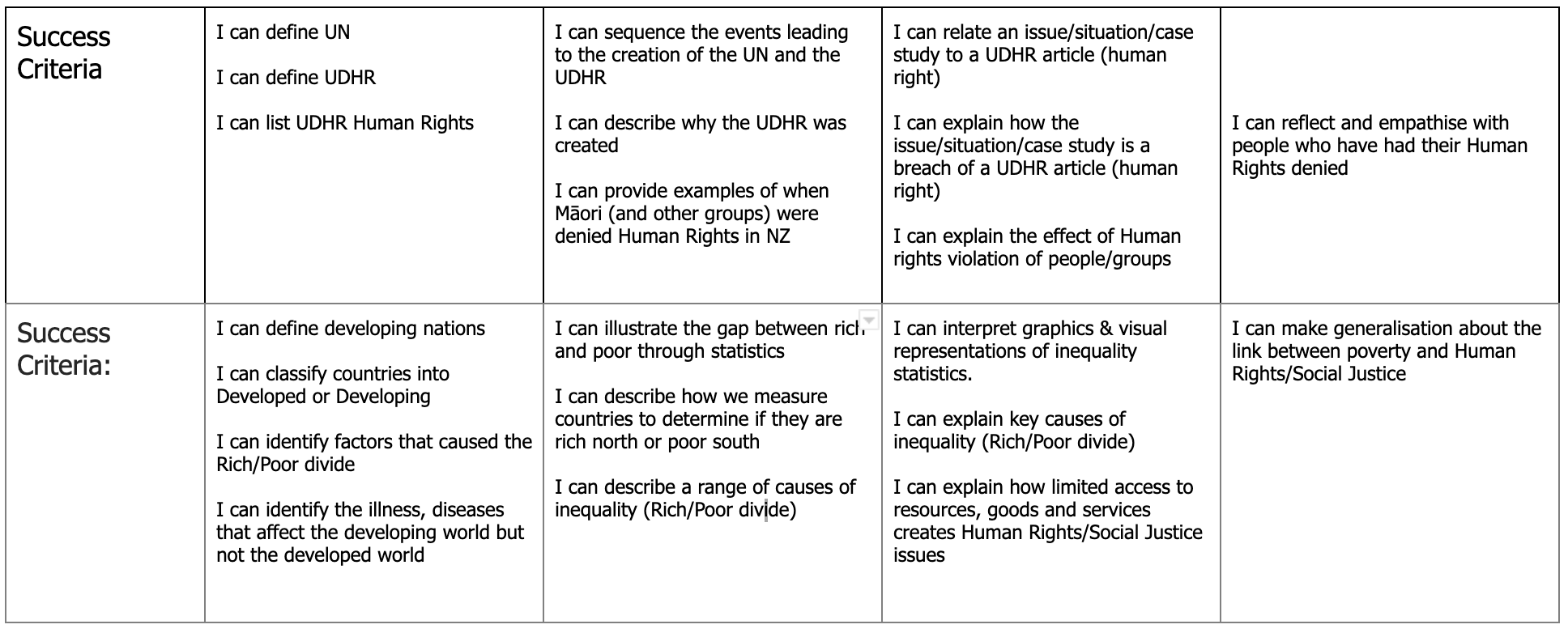
Success Criteria:
Activities:
1. Stereotypes in New Zealand's historical past - case studies
- collaborative group activity
- create a A3 poster to be printed. Use a digital tool to create media poster and enable collaboration
- Each person responsible for an aspect of the poster
- Use the instruction document to understand what needs to be on your poster for each case study2. Introduction to the Universal Declaration of Human Rights
A copy of the activity task has been made for you in the Google Classroom
- video sources and EDpuzzle activity
- reading UDHR
- wordle activity2b - The UDHR: becoming familiar with the Articles
- hard copy handout: simplified version of the UDHR
- cartoon representation: symbolising the 30 articles
- REFLECTION - think about the Monster StereoType Case Studies on your groups poster - list the articles you think were broken and describe how
- Colour code the articles - categorising: hierarchy of most important
Categorising Instructions - use you hard copy UDHR The UDHR is divided into SIX categories.
You need colour code them on their copies.
-
Articles One and Two are the foundation blocks, referring to the principles of liberty, equality etc. that the UDHR is based on.
-
Articles 3 to 11 consist of the rights of the individual, such as the right to life and freedom from slavery.
-
Articles 12 to 17 are about the rights of the individual in civil and political society, such as freedom of movement, the right to privacy and the right to own personal property.
-
Articles 18-21 are concerned with spiritual, public and political freedoms such as freedom of thought, freedom of choosing who we associate with and the right to take part in the governance of our country.
-
Articles 22 to 27 consist of economic, social and cultural rights such as the right to work for a fair wage, access to education and healthcare, the right to celebrate our culture.
-
Articles 27 to 30 bind the others together and lay out our duties to protect these universal human rights. Identify similarities and differences to these categories compared to those created by the students.
Session 5 Friday - Amnesty Guest Speaker
Further Learning....
Complete Activity 2 - Introduction to UDHR - Due Thursday