UNIT 2: Ko au (Me, myself & I)
Section outline
-
Whakataukī
Whāia te iti kahurangi ki te tuohu koe, me he maunga teitei.
Reach for the stars If you have to bow, let it be to a lofty mountain.Tikanga
- The concept of whānau extends beyond parents and children to include grandparents, grandchildren, uncles, aunts, cousins, nieces, nephews, and others.
- Whakapapa is important. It defines a person and his or her links within the whānau and to other groups. It governs the relationships between them.
- Whakapapa is a much broader concept than the concept of a family tree. Through whakapapa, each person may belong to different groups: whānau, hapū, iwi, and waka.
Achievement objectives
Students will:
1.2 introduce themselves and others and respond to introductions
1.4 communicate about personal information, such as [their] name, parents’ and grandparents’ names, iwi, hapū, mountain, and river, or home town and place of family origin
2.1 communicate about relationships between people
3.2 communicate about events and where they take place
3.5 communicate about immediate past activities
4.3 communicate about obligations and responsibilities.
Learning intentions
Possible learning intentions for this unit of work are to:
- recognise, understand, and use familiar words about ourselves and our whānau
- recognise, understand, and use short phrases about ourselves and our whānau
- ask and answer simple questions about another person’s whānau
- communicate about ourselves and other people in our lives using short descriptive sentences
- use “ko” to communicate about our own and other people’s relationships within a whānau
- communicate where we and others live
- understand the form and vocabulary of whakapapa
- communicate about our whakapapa using an appropriate form
- communicate where people were born
- use “rāua ko” to join two people’s names
- use “tino” (“very”) and “tana” (meaning his or her) when describing another person’s appearance or work
- indicate location using “ki” in the context of where people live, their place of work, and their birthplace
- ask and answer a question about my or someone else’s age
- ask and answer a question about the number of people in a whānau
- use ordinal numbers to answer a question about my own or someone else’s place in the whānau
- ask and answer a question about a person’s occupation and where they work.
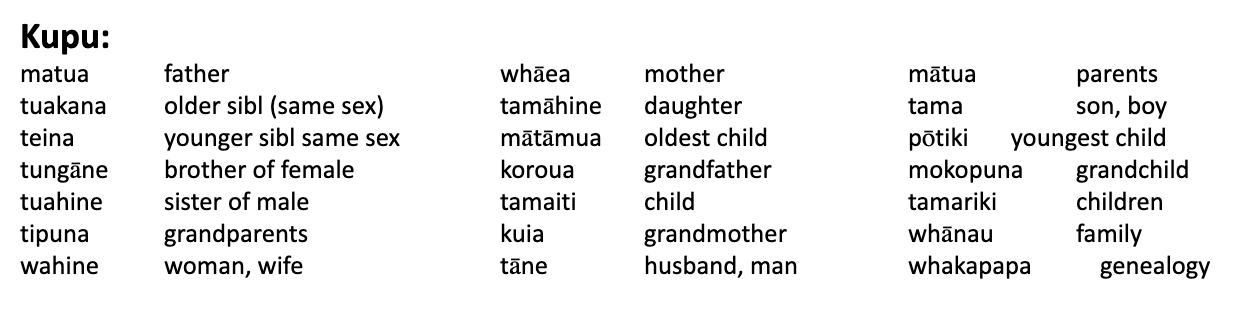
Vocabulary List