
15 March - 21 March
Section outline
-
An example of a New Zealand ocean food web
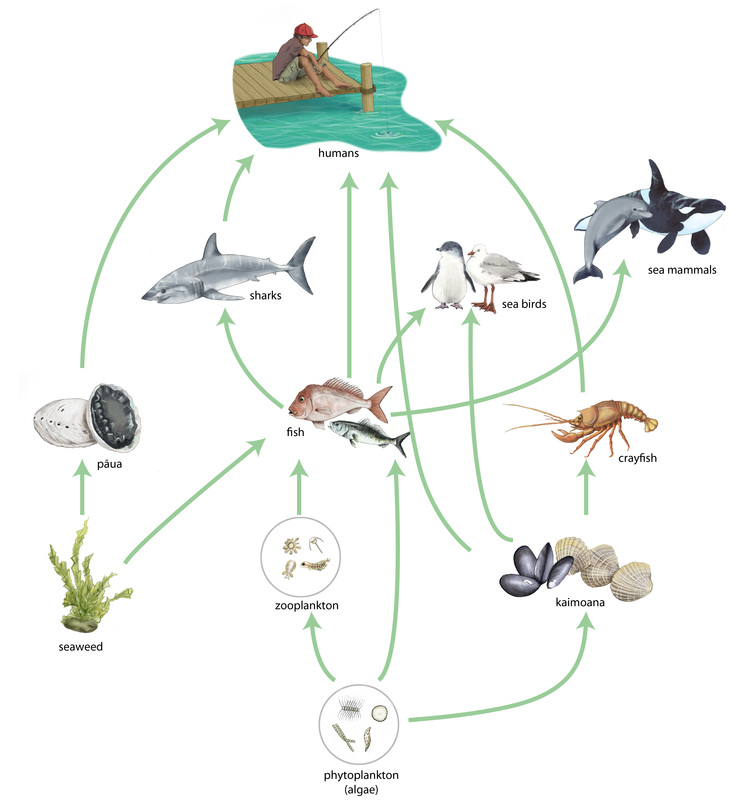
Kia ora 9C1,
Our contextis relationships, The ME in Team!
Big IdeaThis term, across your learning areas, you will be developing your interpersonal skills and learning about leadership, and the role people play in a team or community group.
In time, you will be identifying a community issue and solving the following problem: how do we teach the community about how we can work together to find a solution for the community issue?
Our value is pono, integrity

EXPLORE / TŪHURA learning intentions:
- We are EXPLORING...Life Processes by classifying and organising organisms based on the structural features.
- We are EXPLORING how organisms interact within their ecosystem.
Success Criteria: I can/have...
- outline why scientists classify organisms
- describe the 5 kingdoms of living organisms
- distinguish between vertebrates and invertebrates
- use simple keys to classify unknown organisms or objects.
- distinguish between ecosystems, communities and populations.
- define the term habitat and describe the habitats of a range of organisms.
- describe the relationship between predators and prey.
- construct food chains to show feeding interactions within a community.
- use food chains to construct food webs.
Activities:
- Reading interesting texts to answer questions.
- Watch media to gain knowledge.
- Research.
Google Classroom code: d4kuvuw