Term 1: Week 7
Section outline
-

FOCUS / ARONGA learning intentions:
- We are PRIORITISING and ACKNOWLEDGING tangata whenua by learning our pepeha (in Te Reo).
- We are IDENTIFYING physical and spiritual landmarks that are important to our whakapapa.
- We are EXPLAINING our pepeha/whakapapa to our peers.
- We are FOCUSING on the strong spiritual bonds Māori have with the land - Papatūānuku (the Earth mother).
- We are FOCUSING on the Māori world view of taonga/treasures (such as land, soil and water).
- We are FOCUSING on the Māori concept of kaitiakitanga (guardianship and conservation) of these taonga.
- We are FOCUSING on understanding kaitiakitanga as a source of unity and identity for tangata whenua.
Activities: My Pepeha Essay - Learning to write 'SEXY' paragraphs
1. 'Do Now Task': Shared Reading of Gavin Bishop's 'How Maui Slowed the Sun'
Class discussion:
• What are creation myths - what's their purpose? (...to explain a range of natural phenomenon, how things 'came to be' eg. islands pulled from the sea, tides, the sun, fire)
• What is a demigod? • What character traits can we associate with Maui?
• What do we learn about the Māori way of doing things (tikanga) by reading their myths and legends?
• Two important aspects of tikanga we should be aware of are Manaakitanga and Kaitiakitanga.Manaakitanga - hospitality and kindness.
Kaitiakitanga - is the strong sense of respect and guardianship Māori have for the natural environment. Related concepts are mana, tapu and mauri.
Here is a digital version of this myth, by Peter Gossage 'How Maui Slowed the Sun.'
2. Now let's make an intertextual connection to a modern-day retelling of the feats that made Maui famous - Moana (both the Te Reo Māori and Hawaiian word for ocean). The protagonists in the movie 'Moana' is Maui who is based on a real mythic figure who played a major role in Maori mythology. One way in which Disney's Maui differs from the traditional portrayal of the demigod is that they make him an orphan. Traditionally though, Maui has three brothers and a trickster son or stepson.Here is the catchy Disney musical number where we hear about the feats that made Maui famous, 'You're Welcome!'
3. In Moana, Maui uses his fish hook to turn himself into different creatures and defeat his enemies and adversaries. In traditional Maori lore, Maui did indeed have a fish hook. He used this to pull up the pacific islands from which Polynesia derives its name — Polynesia literally means “many islands.” A couple of these islands just so happened to be modern-day New Zealand. Maui used his fish hook to pull up a huge fish one day and that fish became the North Island.
4. Shared class reading of Peter Gossage's 'The Fish of Maui'
5. Many Māori traditions show a close, mystical relationship between humans and nature. In Māori culture, humans are seen as deeply connected to the land and to the natural world. Kaitiakitanga grows out of this connection (guardianship and protection).
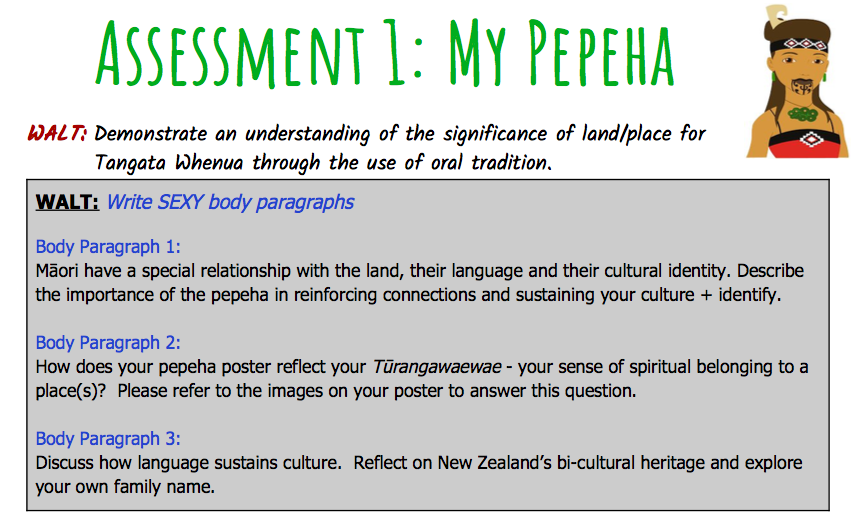
6. Read through 'My Pepeha Paragraph Scaffold' document, below...
7. In groups, research and share brief definitions for the following 12 terms as this will assist you when you start to write your Pepeha essay.
- Māori
- identity
- pepeha
- sustain
- tūrangawaewae
- bi-cultural
- spiritual
- taonga
- whakapapa
- geneology
- world view
- kaitiakitanga
8. Visit Tane Forest to connect with our Papatūānuku (the Earth mother). - Wednesday (social action).
9. Write SEXY paragraphs in exercise books. Publish finished essay onto Google Classroom, with scanned jpeg of your Pepeha Poster at the base of your writing. 'Turn In' to Google Classroom once edited.
Further Learning:
• Please work on your A3 Pepeha poster for homework. Your poster is due on Friday 20th March.